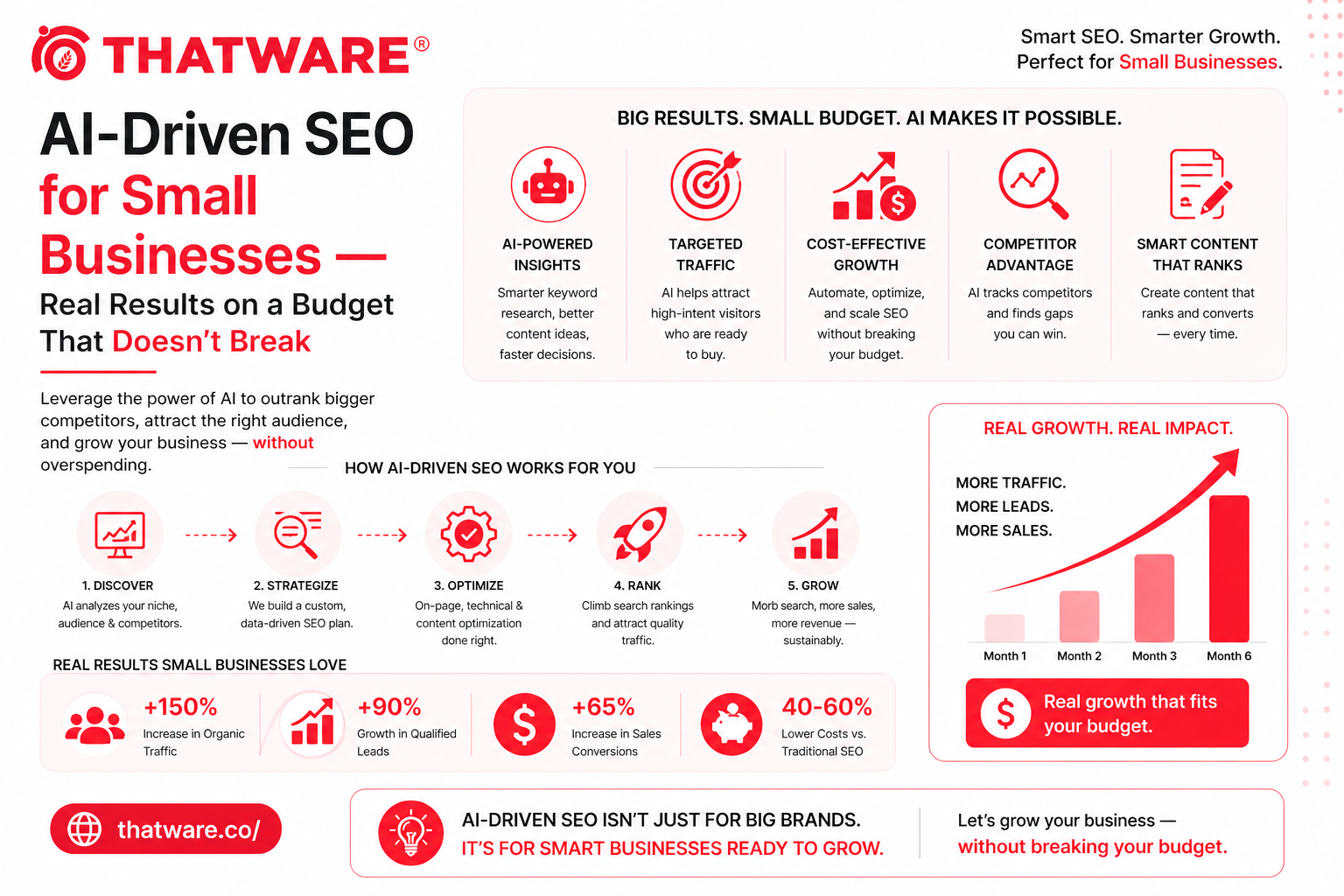
The narrative around AI-driven SEO has been dominated by enterprise use cases. Large brands, large budgets, large content teams, using sophisticated AI tools to optimize at scale. Which is real and worth covering. But it leaves out a significant part of the picture.
Small businesses stand to benefit from AI-driven SEO in ways that are proportionally significant and financially accessible. The cost of AI-powered analysis tools has dropped substantially. The capability of those tools has improved. And the competitive advantage of using them intelligently is, if anything, larger for small businesses operating in local or niche markets than for enterprise brands in fully competitive categories.
Here’s why that’s true and what it looks like in practice.
The Small Business SEO Problem
Small businesses typically have limited time, limited budget, and no dedicated SEO expertise. The person responsible for the website is usually also responsible for twelve other things. Content production happens when someone has bandwidth. Technical issues get fixed when someone notices them. There’s no systematic approach because there isn’t capacity for one.
This is not a failure of intent. It’s a resource reality. And it means that most small business websites are significantly underperforming their potential organic visibility, not because the opportunity isn’t there, but because the consistent, systematic work required to capture it hasn’t been done.
AI-driven tools change this resource equation in specific ways. Analysis that previously required significant hours of expert time now takes a fraction of that. Content research that required deep keyword expertise can be guided by AI tools that surface the relevant data. Technical audits that required specialized knowledge to interpret are becoming more accessible through tools that translate technical findings into actionable recommendations.
What “AI-Driven” Actually Means for a Small Budget
Ai driven seo services for small businesses don’t mean the same thing they mean for enterprise clients. The scale is different, the tools are calibrated differently, and the priorities are different.
For most small businesses, the highest-return SEO work is in a relatively small number of categories: local search visibility, a handful of core service or product pages ranking for relevant queries, and a content program that builds authority in the specific niche the business operates in.
AI-driven analysis for this work focuses on a few things. Which local queries are your most realistic ranking opportunities? What does your Google Business Profile need to compete effectively in local pack results? What does your website need technically to be credibly crawled and indexed? Which content gaps, relative to your local competitors, represent the highest-opportunity targets?
These questions don’t require enterprise-grade analysis infrastructure to answer well. They require systematic analysis applied to the right data, which is increasingly accessible through tools calibrated for smaller-scale use cases.
The Content Efficiency Gain
Content production is often the biggest bottleneck for small business SEO. Creating the volume and quality of content needed to build topical authority takes significant time, which most small business owners simply don’t have.
AI tools for content research and drafting have become genuinely useful here. Not for generating content that publishes directly without human review, which remains a liability, but for accelerating the research phase, generating structured outlines, producing first drafts that a knowledgeable human can then revise and improve.
A small business owner who knows their industry well but struggles to find writing time can use AI drafting assistance to get from a topic idea to a publishable piece in significantly less time than writing from scratch. The content still requires their expertise, their voice, their accurate representation of how their business actually does things. But the mechanical parts of the writing process become more efficient.
Ai seo services that understand small business resource realities build content workflows around this efficiency model rather than assuming unlimited content production capacity.
Local SEO Is Where Small Businesses Win
The most immediate and measurable opportunity for most small businesses in AI-driven SEO is in local search. Local queries, searches with geographic intent, have a different competitive landscape than national or global queries. The competition is typically local businesses rather than large national brands with enormous authority. The ranking factors include signals that small businesses can actually influence.
AI-driven local SEO analysis identifies specific opportunities in local search that aren’t visible in standard national keyword research. Which local queries are underserved relative to business density? Where are competitors weak in their Google Business Profile optimization? What citation and review gaps are suppressing local pack visibility?
These are answerable questions for most local businesses, and the answers point to specific, actionable work rather than overwhelming strategic programs.
Budget Reality and ROI
AI-driven SEO for small businesses can be executed at price points significantly below what enterprise programs cost. This is partly because the scope is narrower and partly because the tools required are increasingly accessible.
The ROI calculation is often more favorable for small businesses than for large ones, because the baseline is lower. A local service business that goes from minimal organic visibility to appearing consistently in local pack results for relevant service queries can see significant revenue impact from that improvement. The uplift percentage from a well-executed small business SEO program can be very large relative to the investment.
The key is focusing the limited budget on the work that produces the highest-return outcomes for the specific business. AI-driven analysis helps identify that focus rather than spreading limited resources across everything.
Organic search is not just for brands with significant marketing budgets. The tools and approaches have democratized enough that a well-run small business with a realistic strategy can capture meaningful organic visibility in its market. The question is whether to do it systematically or to keep leaving that opportunity on the table.